
Fat-Dissolving Injections in Korea: Comparing Kybella, Lemonbottle and Other Lipolysis Brands

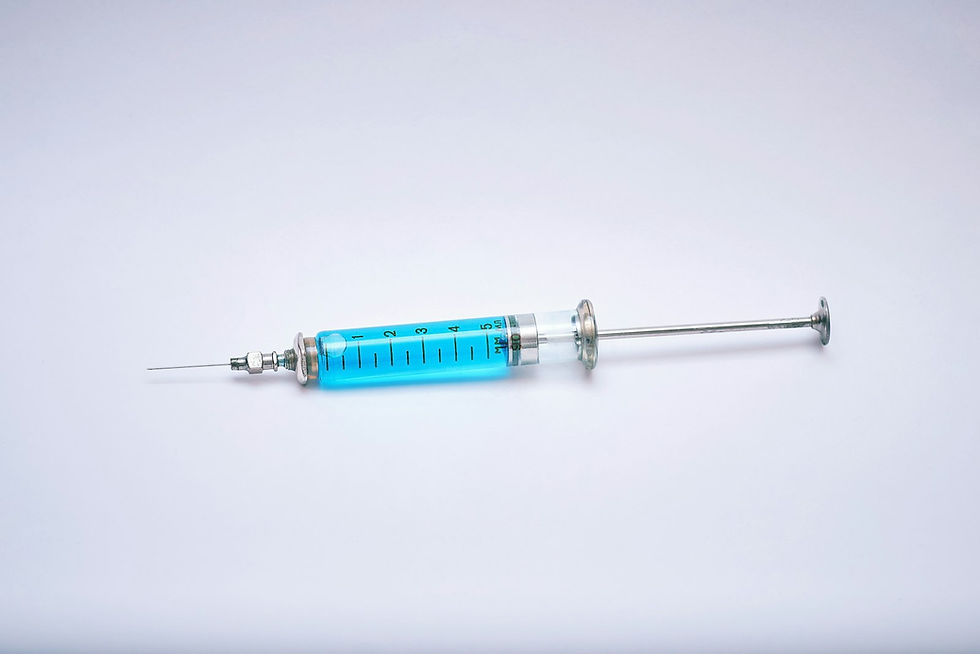
Injectable lipolysis products sold under one marketing phrase differ sharply in what they contain and what has been approved. Photo: National Cancer Institute / Unsplash
Quick answer A fat-dissolving injection is a drug injected into subcutaneous fat to destroy fat cells, and deoxycholic acid is the only active ingredient approved for that purpose in Korea or the United States. Most products marketed under this name in Korean clinics do not hold that approval. The approved ones are licensed for fat under the chin only, and the published efficacy data comes almost entirely from manufacturer-funded trials.
In this guide
Three different things are sold in Korean clinics under the same phrase. One is a drug with a regulatory licence and five randomised trials behind it. One is a compounded mixture that the US Food and Drug Administration has publicly warned about by name. One is a proprietary blend marketed on its ingredient list rather than on any published trial. All three are injected into the same place, cost broadly similar money, and are described to international patients with the same English words. This guide separates them by the one criterion you can verify before you book — what a regulator has actually approved — and then sets out what the published evidence does and does not establish about the products that have any.
What a fat-dissolving injection actually is
"Fat-dissolving injection" is a marketing category, not a drug class. Clinics in Seoul apply it to any syringe-delivered product claimed to shrink localised fat: under the chin, along the jawline, on the upper arms, on the inner thighs. What sits inside those syringes differs enormously.
The mechanism most of them claim is adipocytolysis — chemically rupturing the membrane of a fat cell so that the cell dies and is cleared by immune cells over the following weeks. The American Society of Plastic Surgeons describes injection lipolysis in exactly these terms and names deoxycholic acid as the agent that does the work [4]. That is a real and documented mechanism. The difficulty is that the same mechanism is claimed for products whose formulation has never been assessed by a regulator.
So the useful question is not whether fat dissolving works. It is what exactly is in the syringe, and who approved that specific formulation for this specific use. Korean clinics answer those two questions very differently depending on which product they are selling.
Deoxycholic acid: the one approved ingredient
Deoxycholic acid is a bile acid the body already produces to emulsify dietary fat. In a synthetic injectable form, developed as ATX-101, it is the active ingredient in Kybella, which the FDA approved for reducing submental fat — fat under the chin — in adults. The FDA states plainly that the product "is not approved for use in any other areas of the body" [3].
Korea has its own approved product. V-olet, from Daewoong Pharmaceutical, obtained an indication from the Ministry of Food and Drug Safety in August 2021 for improving moderate-to-severe protruding or excessive submental fat in adults, and the trade press at launch described it as the only submental fat injection with Korean approval [5]. That source is from 2021, so treat the word "only" as accurate for that date and worth re-confirming with the clinic, since approvals change.
Both approvals are narrow in the same way: one ingredient, one anatomical area, adults only. A Korean clinic offering deoxycholic acid for your arms, abdomen or thighs is working off-label. That is lawful and common in aesthetic medicine, but it means the trial evidence summarised below was not collected on the treatment you are being offered.
The other brands Korean clinics offer
Walk into a Gangnam clinic and the product named is often neither Kybella nor V-olet. The alternatives fall into two groups.
The first is compounded phosphatidylcholine and sodium deoxycholate, usually abbreviated to PPC or PCDC. Phosphatidylcholine is a soy-derived phospholipid; sodium deoxycholate is a detergent. The FDA names this combination directly and lists Aqualyx, Lipodissolve, Lipo Lab and Kabelline among products that "pose a significant safety risk because they are unapproved" [3].
The second is the newer wave of proprietary blends, of which Lemonbottle is the best known in Korea. These are marketed on their ingredient lists — riboflavin, bromelain, lecithin — rather than on trial data, and the sales emphasis is usually on comfort and low swelling rather than on measured fat reduction.
Neither group has randomised evidence of the kind that sits behind deoxycholic acid. That does not automatically make them ineffective. It does mean nobody can quote you an effect size or a complication rate with any precision, because the studies that would establish those numbers have not been published.
Side by side: what is approved and what is not
The table below sorts the products by the only variable you can objectively check before booking: regulatory status. Everything else — comfort, swelling, the number of sessions required — is reported by clinics rather than measured in trials for most of these products.
Product | Active ingredient | Approved for fat reduction? | Evidence base |
Kybella (ATX-101) | Deoxycholic acid | Yes — US FDA, submental area only [3] | 5 randomised trials, 1,837 patients pooled [1] |
V-olet | Deoxycholic acid | Yes — Korea MFDS, submental indication, August 2021 [5] | Shares the deoxycholic acid class evidence [1] |
Kabelline | Deoxycholate-based compound | No — named by FDA as unapproved [3] | No published randomised trials |
Aqualyx / Lipo Lab | Phosphatidylcholine + deoxycholate | No — named by FDA as unapproved [3] | No published randomised trials |
Lemonbottle | Proprietary blend (riboflavin, bromelain, lecithin) | No fat-reduction approval | Marketing claims; no published randomised trial |
How effective it is, measured properly
For deoxycholic acid the honest answer is: a real effect, smaller than the marketing implies, and measured almost entirely by the companies selling it.
A 2023 systematic review and meta-analysis pooled five randomised clinical trials covering 1,837 patients aged 18 to 65 [1]. At the 2 mg/cm² dose, patients were about 2.3 times as likely as placebo patients to gain at least a one-point improvement on the clinician-rated submental fat scale (relative risk 2.28, 95% confidence interval 2.04–2.54), and about 8.4 times as likely to achieve at least a 10% reduction in submental volume (RR 8.43, 95% CI 5.73–12.43) [1].
Those are relative figures, not absolute ones. A relative risk of 2.28 tells you the treatment moves more people over a measurement threshold than placebo does. It does not tell you how much fat you personally will lose. The two-point improvement — the one most patients would actually notice in a mirror — carried a relative risk of 5.30 (95% CI 3.85–7.30), which sounds dramatic largely because so few placebo patients reached it at all [1].
What can go wrong, and how often
The same meta-analysis found that side effects track the dose closely. Measured against placebo at 2 mg/cm², numbness carried a relative risk of 13.09 (95% CI 9.48–18.08), fibrosis 9.74 (6.08–15.61) and nodules 5.66 (3.16–10.14) [1]. Roughly 10% of patients in the pooled trials discontinued treatment because of adverse effects [1].
A 2024 systematic review looked specifically at serious events [2]. Marginal mandibular nerve injury, which can produce a temporarily uneven smile, occurred in 4% of trial patients (20 of 513) against under 1% on placebo, with resolution taking a median of 44 days and up to 298 days in the longest reported case [2]. Transient hair loss at the injection site appeared in 4.2% (7 of 167) of patients in an expanded treatment-zone study, resolving in a median of 143 days [2]. Vascular injury, skin ulceration and intra-arterial injection appear in the literature as individual case reports rather than as trial-level rates [2].
For the unapproved products no comparable numbers exist. What exists instead is the FDA's consumer-facing account of what has been reported: permanent scars, serious infections, skin deformities, cysts and "deep, painful knots" [3].

Approval status is the one attribute of an injectable you can verify before booking. Photo: Markus Spiske / Unsplash
Cost and session planning in Korea
Plan the schedule before you plan the budget. ASPS states that most patients need at least two treatments spaced four to six weeks apart, and that up to six sessions are possible; visible reduction is typically seen six to eight weeks after a session [4]. For a visitor on a ten-day trip, that is the central problem. A single session is not a course of treatment, and what you fly home with is swelling rather than an outcome.
Korean clinics usually price per session and per vial rather than per course, so the figure quoted at consultation is rarely the total you will pay. Ask for the cost of the full course at the dose actually planned for your anatomy, and ask whether that figure changes if a third or fourth session turns out to be needed. If you are weighing a quoted price against what domestic patients pay, it is worth understanding that gap before you start negotiating.
If the timetable does not fit your trip, a single-session device-based or surgical approach may suit a short visit better than an injectable course that needs you in Seoul three times.
Questions to ask before you agree
Most of the risk in this category is not clinical. It is informational: patients consent to "a fat-dissolving injection" without ever learning which product entered their body. Ask these before paying a deposit, and ask for the answers in writing.
Before you consent 1. What is the product's brand name and active ingredient, written down? 2. Is it approved by Korea's MFDS for fat reduction in the specific area you are treating? 3. How many vials per session, and how many sessions are planned in total? 4. Who performs the injection — the consulting doctor, or another staff member? 5. What is the clinic's written plan if nerve weakness, a nodule or an ulcer appears after you have flown home? |
The last question is the one international patients most often skip, and the one that matters most once the plane has landed. If the answers are vague, a second opinion at another clinic costs far less than managing a complication from abroad.
What the research says
Inocêncio et al., 2023 — a meta-analysis of five randomised trials
Design and participants. A systematic review and meta-analysis of five randomised clinical trials comparing deoxycholic acid (ATX-101) with placebo, pooling 1,837 patients aged 18 to 65 [1].
Main results. At 2 mg/cm², relative risk 2.28 (95% CI 2.04–2.54) for a one-point clinician-rated improvement, 5.30 (3.85–7.30) for a two-point improvement, and 8.43 (5.73–12.43) for at least a 10% reduction in submental volume. On the harm side, numbness carried RR 13.09 (9.48–18.08) and fibrosis 9.74 (6.08–15.61) [1].
Limitations. All five included studies reported industry funding or sponsorship, and the authors concluded that all of them showed an industry sponsorship bias. Only two of the five were judged at low risk of bias; the other three raised "some concerns." Certainty of evidence was moderate for 11 outcomes, low for 16 and very low for one [1].
What this means for a patient. The direction of the effect is well supported — the drug does something placebo does not. The size of the effect, however, comes almost entirely from trials run or funded by the manufacturer. Read the efficacy figures as an optimistic bound rather than as a typical result.
Shridharani and Kennedy, 2024 — a systematic review of serious adverse events
Design and participants. A systematic review of MEDLINE and PubMed for serious adverse events following ATX-101 injection for submental or jowl fat, covering publications before 26 July 2023. Of 281 records identified, 26 were included for data extraction, supplemented by the corresponding author's experience of approximately 5,000 procedures. The authors rated it level of evidence 3 [2].
Main results. Marginal mandibular nerve injury in 4% of trial patients (20 of 513) versus under 1% on placebo, resolving in a median of 44 days; alopecia at the injection site in 4.2% (7 of 167) in an expanded treatment-zone study, resolving in a median of 143 days; and individual case reports of vascular injury, ulceration, abscess, intra-arterial injection and one temporary ulnar nerve palsy [2].
Limitations. Much of the evidence is case reports and single-operator experience rather than controlled data. The search used one database and one search string, and the trials reviewed did not separate haematoma from ordinary bruising. The first author discloses advisory and consulting relationships with the manufacturer, which also funded the medical writing [2].
What this means for a patient. Serious complications are uncommon but genuinely occur, and almost all of those documented resolved with time rather than requiring surgery. That is only reassuring if you have access to follow-up care during the weeks or months it takes to resolve — which is precisely what a short medical-travel trip does not provide.
Frequently asked questions
Is Lemonbottle approved in Korea for fat reduction?
It is widely used in Korean clinics, but it does not hold a fat-reduction approval of the kind deoxycholic acid holds. The FDA's warning addresses unapproved fat-dissolving injections as a category and names several comparable products by brand [3]. Ask the clinic to show you in writing what the product is licensed as and by which authority.
Can these injections be used on the stomach, arms or thighs?
Clinics do offer this, but no regulator has approved deoxycholic acid for any area other than under the chin [3]. The trial evidence described above was collected on submental fat only, so neither the efficacy figures nor the complication rates transfer reliably to other parts of the body.
How many sessions will I need, and can I complete a course in one trip?
ASPS states that most patients need at least two sessions four to six weeks apart, with up to six possible, and that results become visible six to eight weeks after a session [4]. A single trip to Korea rarely accommodates a full course, which is worth factoring into both cost and expectations.
What should I do if a lump or numbness appears after I return home?
Firmness and numbness after deoxycholic acid are common and usually temporary; in the reviewed data, nerve-related weakness resolved in a median of 44 days [2]. Agree a remote follow-up route with the clinic before you leave Korea, keep the written product and dosing record, and see a local doctor promptly if you develop spreading redness, severe pain or an open wound.
References
Inocêncio GSG, et al. Efficacy, safety, and potential industry bias in using deoxycholic acid for submental fat reduction – A systematic review and meta-analysis of randomized clinical trials. Clinics (São Paulo), 2023. PMID 37806137. DOI 10.1016/j.clinsp.2023.100220
Shridharani SM, Kennedy ML. Management of Serious Adverse Events Following Deoxycholic Acid Injection for Submental and Jowl Fat Reduction: A Systematic Review and Management Recommendations. Aesthetic Surgery Journal Open Forum, 2024. PMID 39247122. DOI 10.1093/asjof/ojae061
U.S. Food and Drug Administration. Using Fat-Dissolving Injections That Are Not FDA Approved Can Be Harmful. FDA, content current as of 20 December 2023.
American Society of Plastic Surgeons. Injection Lipolysis. ASPS, nonsurgical fat reduction procedure guide.
청년의사 (Korean Doctors' Weekly). 대웅제약, 턱밑 지방 개선 주사제 '브이올렛' 출시. 14 October 2021. (Published 2021; re-confirm current Korean approval status with the clinic.)
Related reading
Lemonbottle Fat Dissolving Injection in Korea: Complete Guide
Cryolipolysis vs Injection Lipolysis vs Liposuction (2026): A Body Contouring Decision Guide
Do Korean Clinics Charge Foreigners More? Domestic vs Foreign Patient Quotes
ECM Skin Boosters in Korea: What Extracellular Matrix Injectables Actually Do
About this guide. Korean Plastic Surgery Info is an independent information service for international patients considering treatment in Korea. We do not operate a clinic, and we receive no commission from any clinic, manufacturer or product named on this page. This article summarises published peer-reviewed research and official regulatory statements, each linked in the references above. It is general information, not medical advice, and it cannot replace an in-person assessment by a licensed physician. Published 22 October 2026.


Comments